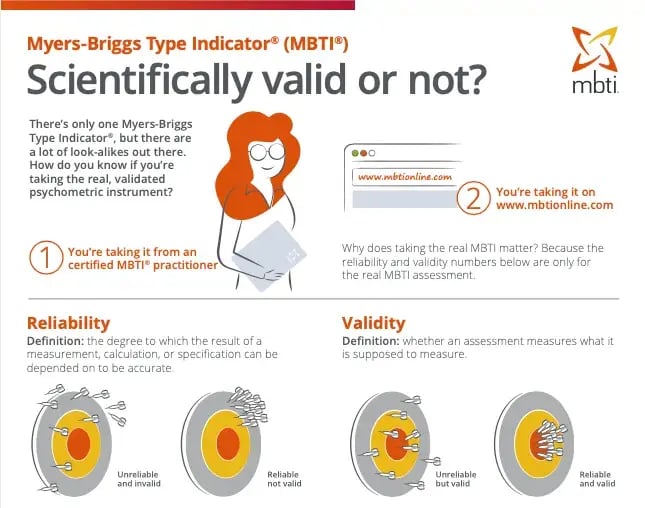
Yes. Four editions (1962, 1985, 1998, 2018) of its manual have been published, providing a wealth of research-based evidence on its reliability and validity. The manual also explains the theory behind the assessment, its construction, and the data collection and analysis of the scales.
Sources of scientific research on the MBTI® assessment
When psychologists or practitioners evaluate a psychometric test or questionnaire, they usually ask two main questions: “Is it reliable?” and “Is it valid?” On both of these criteria, the MBTI assessment performs well. Reputable psychometric tools have been developed through years of rigorous research, and The Myers-Briggs Company makes these research findings available via the MBTI® Manual for the Global Step I™ and Step II™ Assessments (Myers, McCaulley, Quenk, & Hammer, 2018). This manual is provided to all certified practitioners as part of their certification materials. Major findings are also published in data supplements that can be downloaded from The Myers-Briggs Company website for the current commercial version and prior commercial versions.
In addition, there are many articles by independent researchers in established journals. Interested parties can find hundreds of these on a free searchable database published by the Center for Applications of Psychological Type (CAPT), called Mary and Isabel’s Library Online (MILO), at www.capt.org/MILO.
Finally, the MBTI assessment meets the stringent requirements for psychological assessments in psychology societies around the world (e.g., the British Psychological Society, The Health Professions Council of South Africa, and Sistema de Avaliação de Testes Psicológicos in Brazil). Furthermore, the MBTI assessment has been voluntarily submitted to organizations in the United States for independent review such as those provided in Buros Mental Measurements Yearbook, in Psyctests by the American Psychological Association, and in the Comprehensive Guide to Career Assessment (7th ed.) published by the National Career Development Association (NCDA). Note that the American Psychological Association (APA) does not approve or disapprove the use of assessments in the United States. Instead, the APA provides ethical guidelines that put the onus on the users of assessments to evaluate their reliability, validity, and appropriateness.
References
Myers, I. B. (1962). Manual: The Myers-Briggs Type Indicator®. Princeton, NJ: Educational Testing Service.
Myers, I. B., & McCaulley, M. H. (1985). Manual: A guide to the development and use of the Myers-Briggs Type Indicator® (2nd ed.). Mountain View, CA: CPP, Inc.
Myers, I. B., McCaulley, M. H., Quenk, N. L., & Hammer, A. L. (1998). MBTI® manual: A guide to the development and use of the Myers-Briggs Type Indicator® Instrument (3rd ed.). Mountain View, CA: CPP, Inc.
Myers, I. B., McCaulley, M. H., Quenk, N. L., & Hammer, A. L. (2018). MBTI® manual for the Global Step I™ and Step II™ assessments (4th ed.). Sunnyvale, CA: The Myers-Briggs Company.
Psyctests. (n.d.). Retrieved October 2, 2019, from https://www.apa.org/pubs/databases/psyctests/.
Stoltz, K. B., & Barclay, S. R. (2019). A Comprehensive Guide to Career Assessment. Broken Arrow, OK: National Career Development Association.
University of Nebraska-Lincoln. (n.d.). Mental Measurements Yearbook. Retrieved October 2, 2019, from https://buros.org/mental-measurements-yearbook.