Why Choose the MBTI® Assessment?

Green Tick

The world’s most popular personality assessment

The MBTI® assessment—the original personality assessment—has stood the test of time for over 80 years because it works. It’s used by leading business, government, and educational organizations, including 88% of Fortune 500 companies, as well as countless L&D and OD professionals to support their people development strategies

Green Tick

Accelerates soft skills development

Building on self-awareness, the MBTI assessment provides a pathway for skills development through the lens of personality type. A comprehensive suite of reports and support materials enable practitioners to create personalized, scalable learning that enhances communication, collaboration, conflict management, leadership, and more.

Green Tick

Seamless onboarding for new users

With convenient options for certification training, a structured onboarding process, and access to a wealth of resources, new MBTI practitioners can quickly and successfully implement the MBTI assessment within their organization.

Green Tick

Backed by decades of research

Extensively reviewed by scientists and researchers over decades, the MBTI assessment is supported by a robust body of evidence that demonstrates its reliability, validity, and enduring relevance.

Organizations and Consultants: We Have You Covered.

Getting started with the MBTI assessment is easy. Through our certification program, you’ll learn everything needed to administer the assessment, interpret results, and apply it for people development initiatives. As a certified MBTI practitioner, you’ll also gain access to tools, resources, and support to ensure your continued success.

Practitioner Certification

Practitioner Certification

Curated Resources and Continuing Education

Curated Resources and Continuing Education

 Deepened Connections with Like-Minded Practitioners in Our Community
Deepened Connections with Like-Minded Practitioners in Our Community
Top Reports


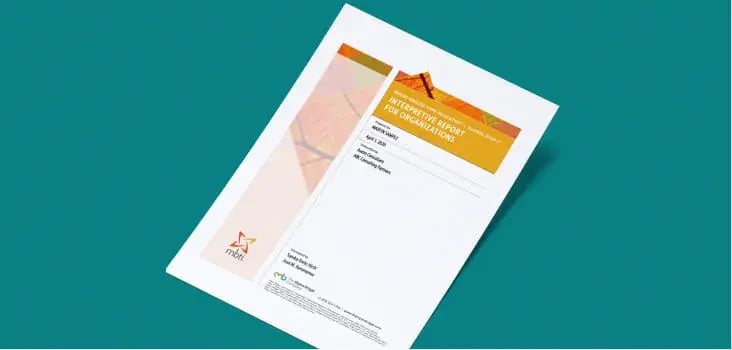
         Interpretative Report for Organizations

Interpretative Report for Organizations

Helps individuals improve workplace effectiveness by exploring how their personality type may be expressed in an organizational setting.

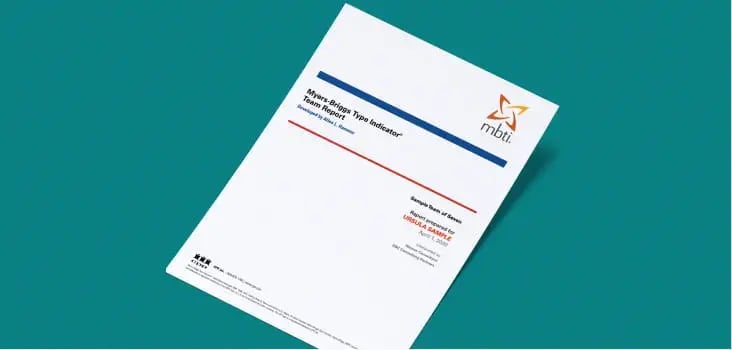
MBTI Team Report

Team Report

Helps teams improve collaboration and performance by exploring how personality type affects both team dynamics and contributions of individual members.

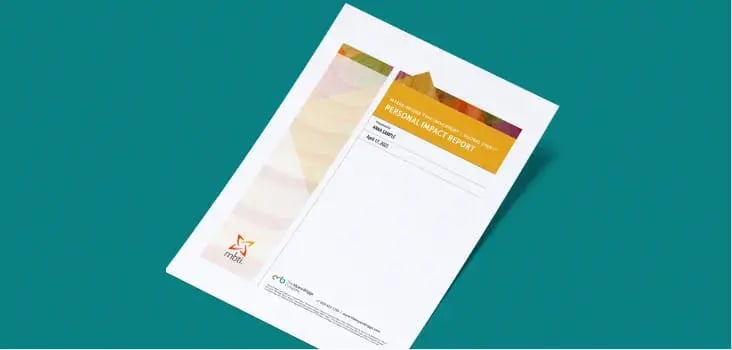
MBTI Personal Impact Report

MBTI® Personal Impact Report

Delivers our most comprehensive development experience to help individuals maximize their effectiveness across eight key areas essential to personal and professional success.

Ready for MBTI® Certification?

mbti cert

Advanced Users

Combining the MBTI with other assessments adds more depth to your development strategy.

mbti tki

MBTI + TKI

Offers more powerful insights into managing conflict productively by understanding the intersection between conflict styles and personality preferences.
mbti strong

MBTI + STRONG

For a more holistic approach to career exploration that considers both personal interests and personality type.
mbti firo

MBTI + FIRO

A versatile coaching tool that provides insights into one's personality type and interpersonal needs to enhance individual and leadership effectiveness.

Accept No Imitations: 7 Strengths of the Original MBTI® Assessment.

Built for development. Backed by research. Discover why the MBTI® assessment still leads the field.
thumbnail

Ready to Explore What’s Possible with the MBTI® Assessment?

We'd love to help.

Frequently asked questions

Here’s our community’s top questions about our certification program.

Where can I take Myers-Briggs® personality tests ?

The Myers-Briggs assessment is the world’s most trusted and widely used personality assessment. If you’re a student, inquire with your academic advisor or career counselor about taking the assessment. If you’re employed, your HR manager may be able to offer you the assessment. Or the assessment is available to individuals online.

Can you cheat on the Myers-Briggs® test?

The MBTI® assessment is not a test because there are no right or wrong answers and there is no best type to be. Wanting to “cheat” makes no sense as the assessment aims only to identify your personality preferences in order to support self-awareness and personal development. The MBTI® assessment is not suitable to be used in any other way, for example in selection, where results may be a more relevant indicator of success.

Do you offer a 16 personality type quiz or a four letter personality test?

The MBTI® questionnaire is not a test or a quiz. It helps you understand yourself and others; there are no right or wrong answers and there is no best type to be. The MBTI® assessment provides insight by exploring which four letters most accurately describe your personality: I (Introversion) or E (Extroversion); S (Sensing) or N (iNtuition); T (Thinking) or F (Feeling); and J (Judging) or P (Perceiving). These four letters combine to one of 16 possible MBTI® types.

What is the MBTI® test?

The Myers-Briggs Type Indicator® (MBTI®) assessment is not a ‘test,’ because there are no right or wrong answers. It is designed to help you better understand what makes you uniquely you. It also shows you how you relate to others, and how you can benefit from this knowledge in everyday life.

Why can’t I use the MBTI® assessment for recruitment if I know I want a particular “type” of person to fill a gap in a team?

The MBTI® assessment should never be used in recruitment or selection because it does not measure a person's skills or abilities—just their underlying personality preferences. These preferences are not necessarily reflected in their behavior, because as complex and adaptable human beings, we are able to modify our behavior according to what is most appropriate and useful in any given situation.

The MBTI® assessment is not constructed using scales that can predict a person's behavior; instead, it uses broad categories to describe what motivates us.
The MBTI® instrument is not designed to be used as a selection tool. It is a process, and respondents are encouraged to decide which MBTI® type best fits them, and then to determine what this means for them. It is simply not appropriate to use in a selection context.

There are many personality assessments on the market that have inbuilt mechanisms to make them ideal for selection, such as the CPI®.

Can the MBTI® questionnaire be used for those under 18 years of age?

Although there is no set cut off point for using the MBTI® tool with younger people, as long as they have the reading capacity to understand the questionnaire, it is generally recommended that the MBTI® tool is not suitable for those younger than 13 years of age. There is the MMTIC (Murphy-Meisgeier Type Indicator for Children ), which is available for use with children in grades 2-12 (ages 7-18), but it is aimed mostly for ages 7-12. The MMTIC assessment can help children understand themselves better while providing parents and teachers with better tools and insights to reach children with different learning styles. Find out more from People Stripes.

For young adults (16-24), the MBTI® assessment can be extremely useful for learning styles, self-awareness, working with others, and career counseling.

When administering the MBTI® assessment to young adults, emphasize that the process is voluntary and confidential, and reinforce the individual's own part in determining the results. This is particularly important as teachers, counselors, or professionals who administer the tool will probably be seen as authority figures, so a respondent's answers may not be natural. Peer pressure and social desirability may be strong influences if the participant think that their results may be shared.

When giving feedback, it is important to ensure the questions asked are relevant to someone who is not in a work environment, so asking about how they work with other students on projects, for example, may be more applicable to them


What do the Myers-Briggs® letters mean?

The Myers-Briggs® assessment helps you to identify your preferred way of doing things in four key areas. The letters refer to your preferences for:

  • Directing and receiving energy—I (Introversion) or E (Extroversion)
  • Taking in information—S (Sensing) or N (iNtuition)
  • Making decisions—T (Thinking) or F (Feeling)
  • Approaching the outside world—J (Judging) or P (Perceiving)

What does the Myers-Briggs® assessment tell you about yourself that you don't already know?

The full interpretation process provides numerous insights into the way you think and behave, shedding invaluable light onto how you interact with others at work and in your personal life. Using the MBTI® framework, you can consciously flex your natural style to improve communication, manage conflict more effectively, and make better decisions. It also very usefully provides a common language with which to talk about personality differences with other people.

How can Myers-Briggs® compatibility help me?

The self-awareness you gain through the MBTI® assessment allows you to understand yourself and others better, so you can enhance your relationships with others.

Where can I take the MBTI® online test?

The MBTI assessment is available online at MBTIOnline.com.

Can I be educationally eligible to administer the MBTI®?

Specific requirements must be met for you to purchase and administer the Myers-Briggs Type Indicator® (MBTI®) assessment. You can meet these requirements either by successfully completing a certification program and receiving the designation Certified Practitioner or by being granted education eligibility. Learn more.

What is the difference between MBTI® Step I™ and Step II™?

MBTI® Step I™ is the first and most well-known form of the MBTI® assessment. It sorts you into one of 16 types. You find out your best-fit type via a facilitated session, usually with a qualified MBTI® practitioner.

MBTI® Step II™ is a slightly longer version of the questionnaire that goes into greater detail by providing information on five facets linked to each letter of your MBTI® type. It complements Step I by giving a more granular view of your personality preferences, motivations, and outlook, and can be used to explain things about your personality that might seem inconsistent or confusing. It can also help you to clarify your Step I best-fit type.

Note: It is possible to order Step I reports from a Step II questionnaire. So, if you know someone is going to use MBTI® Step II™ at some point, they should complete that questionnaire at the start of their MBTI® development journey.